
THE STORYTELLERS
Narrative takes centre stage here. Each print invites you into a world of imagery, symbolism, and imagination, where personal stories and collective experiences unfold through the artist’s hand.
Booth 32
FLORA MCLACHLAN | JOURNEYING, 2025
Flora McLachlan RE RCA is an artist whose work seeks to awake a state of enchantment. Flora cultivates a magical consciousness through her artistic practice. Her images are born in materiality, using impermanent and chaotic etching grounds to let chance in. The copper plate enters the mordant as into a witch’s cauldron: working like this, she is casting spells. She imaginatively reworks these marks to evoke her ambiguous, dreamlike stories. Each work is bound into a tentative and poetic personal mythology. Flora's work evokes a sensory immersion in a numinous place. Imagined myths and fragments of dream surface and tangle like seaweed in the tide.
Booth 7
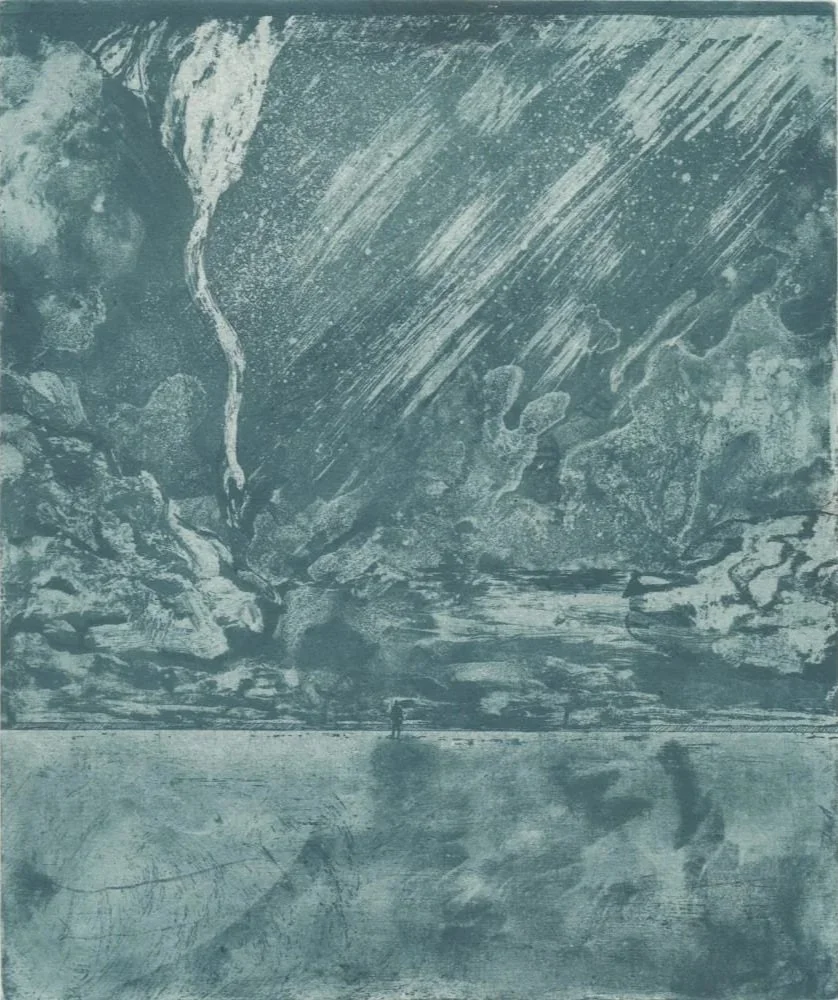
REBECCA FIELDING | SWAN DIVE, 2025
Rebecca Fielding is a fledgling artist living and working in Glasgow. She trained as an Art Historian and was particularly interested in the global story of creative practices. “The print ‘Swan Dive’ is one in a series by the artist inspired by her dreams. Although the memory was blurry and ephemeral, the image of a monumental swan lingered long after she woke up. From this an initial concept was developed, playing into the surreal image, using the comparative size of a human figure to enhance the overwhelming scale felt in the dream. To produce the image the artist employed the etching technique of soap ground, creating watery and, at times, unpredictable textures. The result is the swan being observed as if at an aquarium, however there is an intended ambiguity left for the viewer to find their own meaning.”
Booth 7
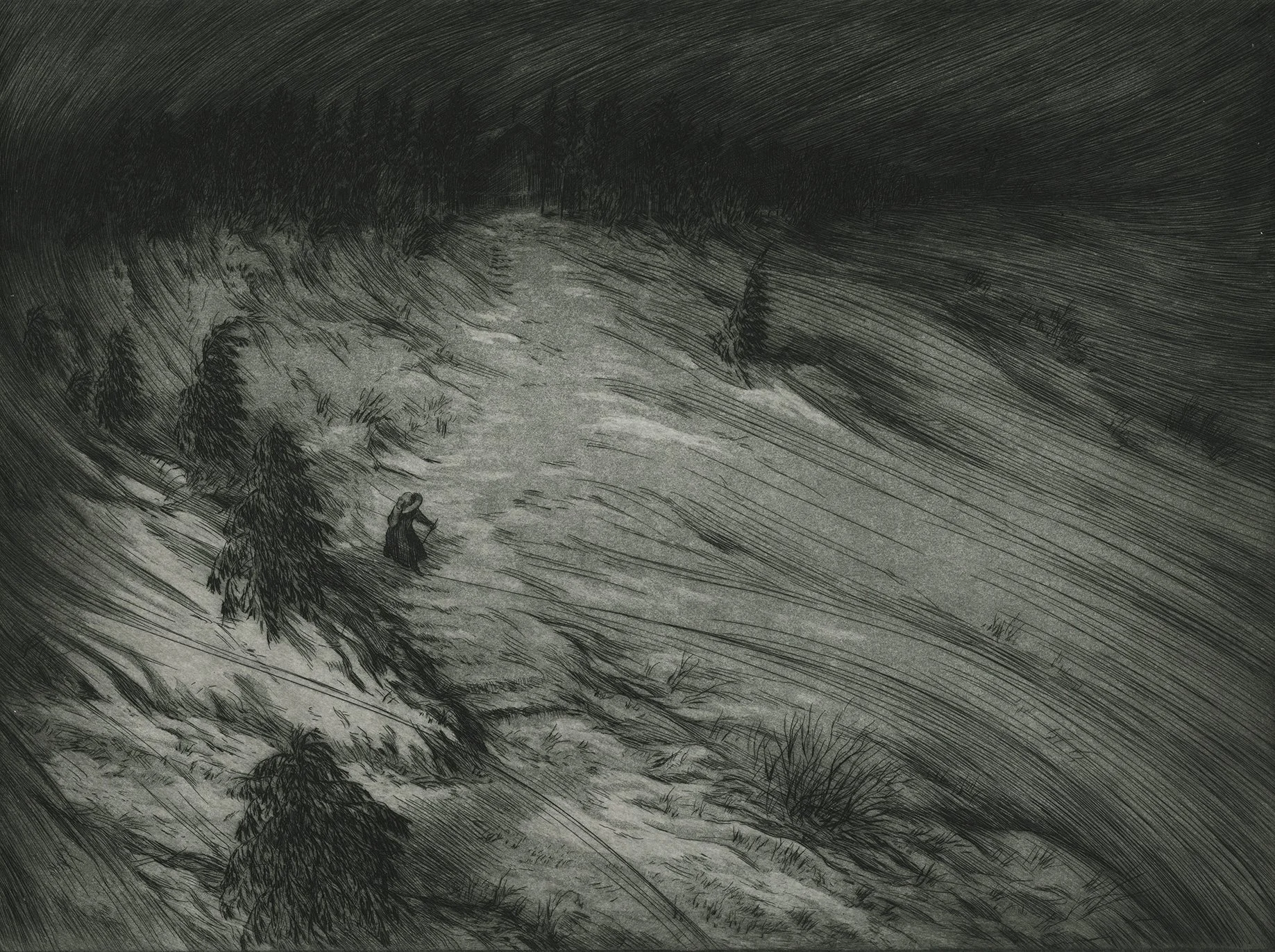
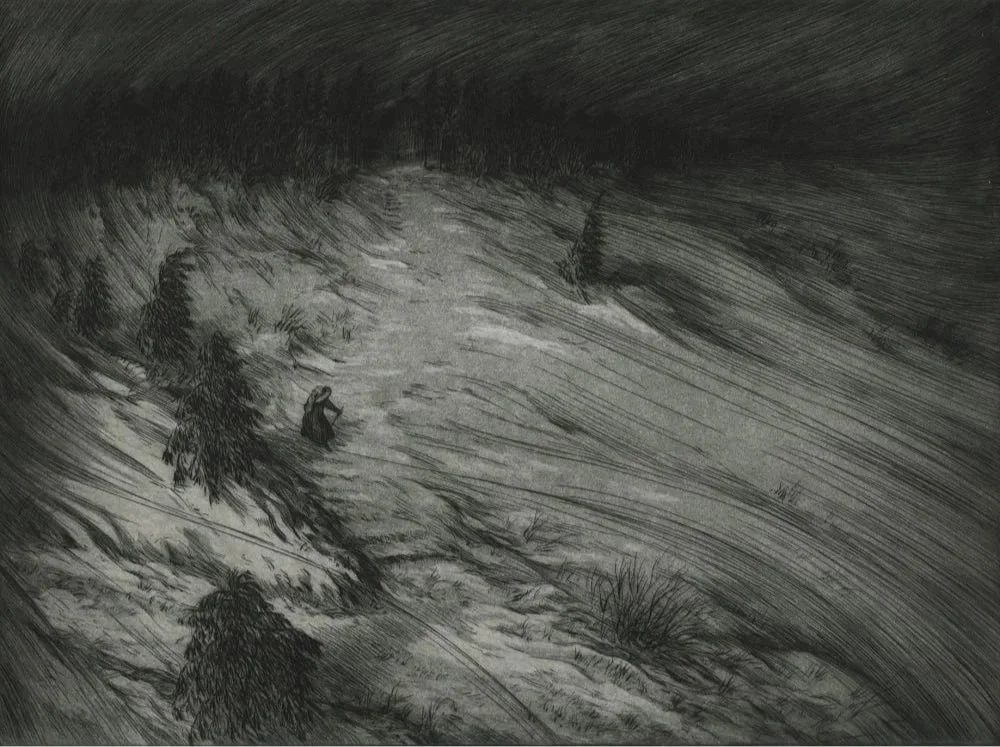
INKEN STABELL | WINTERREISE - DIE WETTERFAHNE (WINTER JOURNEY - THE WEATHERVANE), 2025
Die Wetterfahne (The Weathervane) is the second of the 24 songs of Franz Schubert’s Winterreise song cycle. The wanderer leaves home and love behind as he starts his solitary journey during a stormy winter night, believing the weathervane on top of the house to mock his departure and emotional turmoil. The song is one of the most energetic ones of the cycle, and the same goes for this illustration among all 24 pieces. Made on a 40 x 30 cm zinc plate with layers of line-etching and spray paint aquatints.
Booth 6
THOMAS WH COMPTON | WHERE BARROWS GROW, THE FOUR LEGGED FALL SILENT, 2025
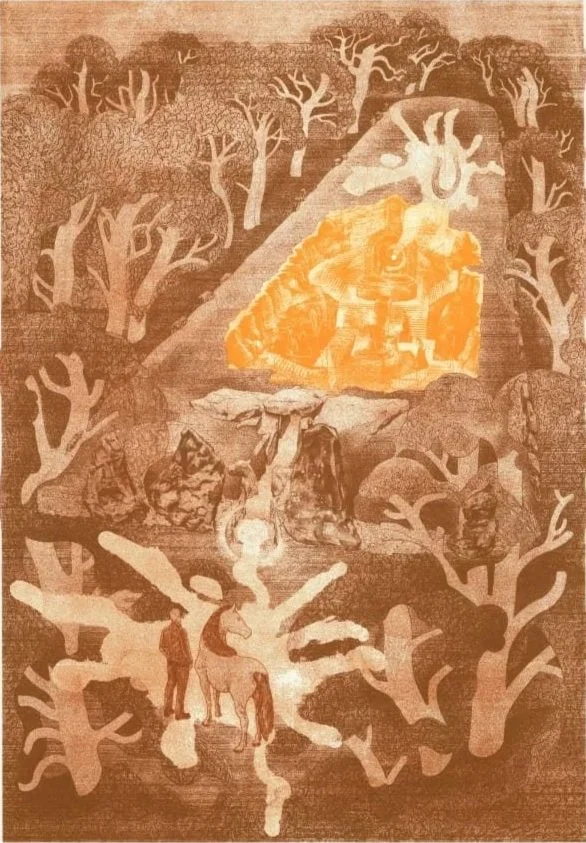
'Where Barrows Grow, the Four Legged Fall Silent' traces a shift from nomadic vastness to settled ritual and control. Anchored in the Neolithic installation ‘A Hymn in Fibres, Flesh and the Human Register’, it reflects a change in human consciousness—from awe to authority, multiplicity to monoculture. Central to the work is Wayland’s Smithy, a Neolithic long barrow in Oxfordshire, where impressions of tree, cave, horse, and human merge in a visual archaeology blending myth and architecture. The unseen smith Wayland haunts the barrow, his craft buried beneath stone and story. Inside, the glowing barrow pulses with remembered power; outside, mute figures stand with their domesticated horse, a ghostly echo of wild kin subdued. The piece captures humanity’s fractured bond with nature, reducing multiplicity to familiarity and seasonal return. Silkscreen techniques use earthy pigments and tonal compression to dissolve ghostly forms into layered vegetation and ritual geometry, yet within this is resistance—the barrow glows, the forest encroaches, and myth lingers, feral and unresolved. The work serves as both elegy and invocation: mourning the lost wild mind and quietly calling to reawaken to what lies beyond cultivation.
Booth 32
RUDOLPH TAYLOR | LOVER'S GARDEN II, 2025
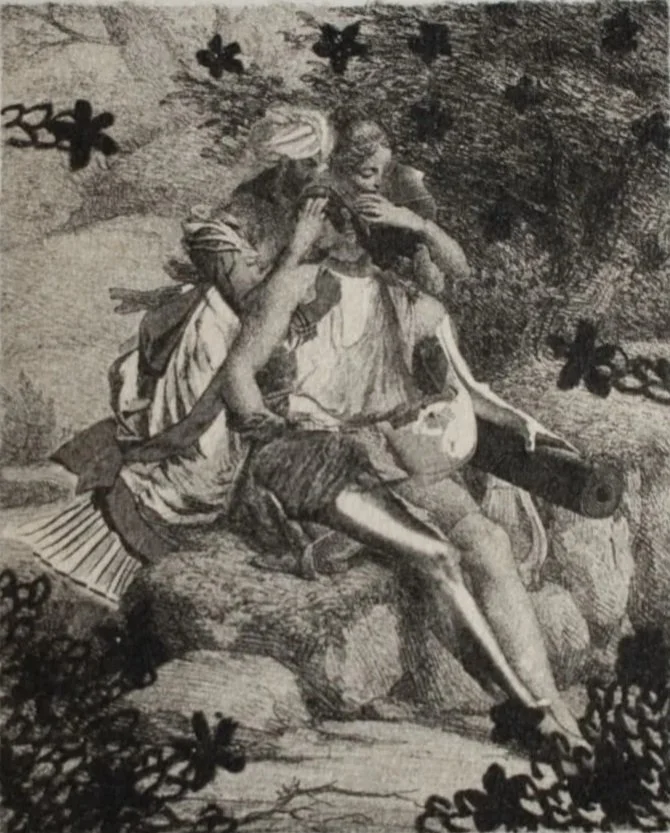
Rudolph Taylor is an artist and printmaker whose work expands on how classical representation can be used to show an increasingly global and multicultural world. Through the use of archives and utilizing his skills as collaborative printmaker, Rudolph utilizes collage and drawing to reinterpret classical western art to reflect the world today. Mixing up bodies with clothing and objects from across the world and centuries he depicts the complexity of being multiracial, while also creating a space in which these individuals can exist in the fullness of their multifaceted identities. Two lovers embrace in a playful surprise, the garden blooms around them. Each made by their own mixed up histories and places, it matters not where and when they come from, but that they found each other now. For here and now, in their garden, their love can bloom.
Booth 9
OLGA GEOGHEGAN | MARIUPOL, 2022
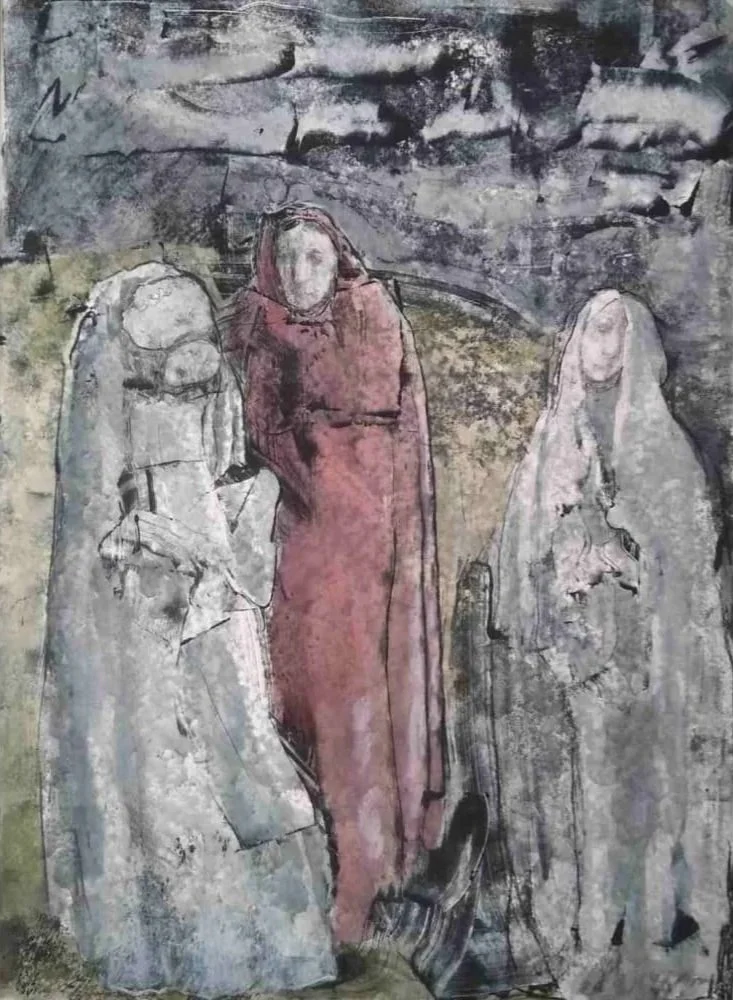
Olga Geoghegan originally trained as a painter at the She studied at the Petersburg Academy of Arts, but upon her arrival in the UK, she developed an interest in graphics after winning a place in the Drawing Year at the Royal Drawing School in London. Painting from the ‘head’ rather than from ‘nature’, she employs various media to release her subjects from their abstract print backgrounds, creating ethereal monoprints that inhabit a mythical, psychological space.
For a year after Ukraine's invasion in February 2022, she couldn’t create, overwhelmed by despair, confusion, and pain. Recovery from shock, like mourning, usually takes a year. Being an artist is fortunate—pain accumulates like a pregnancy, eventually expressed as creation.Thus, after a year, she created a small series of graphic works about the war, of which this work is one.
Booth 6
LOUIS NYE | WILD THINGS, 2025
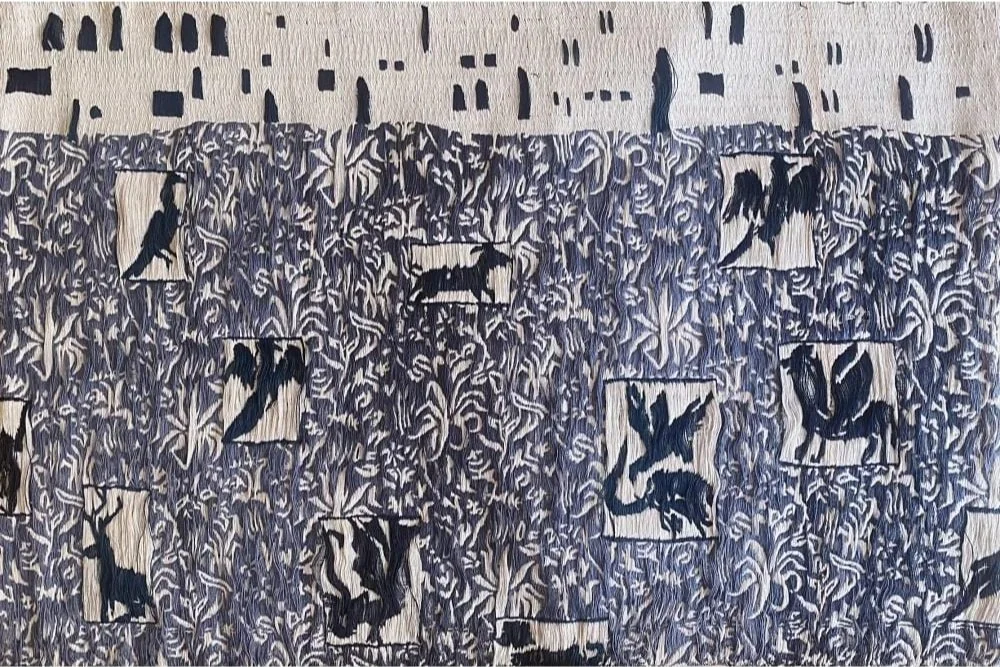
Wild Things’ is based on a 1525 tapestry in The Burrell Collection titled ‘Birds and Beasts in a Landscape with a Mille-Fleurs Ground’, where wild creatures like griffins and wyverns are depicted alongside dogs, herons and falcons on a mille-fleurs (thousand flower) ground. There’s a flatness unique to tapestries of this period where pattern and figures battle for space. The encyclopaedic level of detail creates a maximalist effect where the viewer can get lost within the wildness of the tapestry. In some areas it feels ordered, while in others it lurches towards chaos. Nye wanted to capture this visual battle in the competing languages of instinctive woodblock and ordered weave.
Booth 39
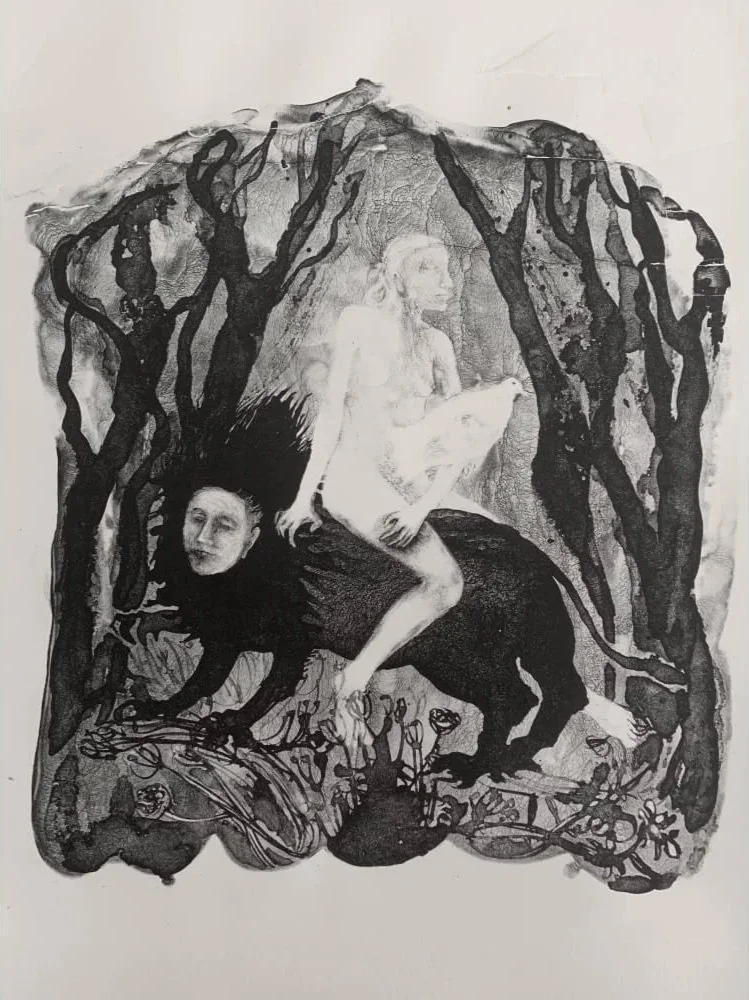
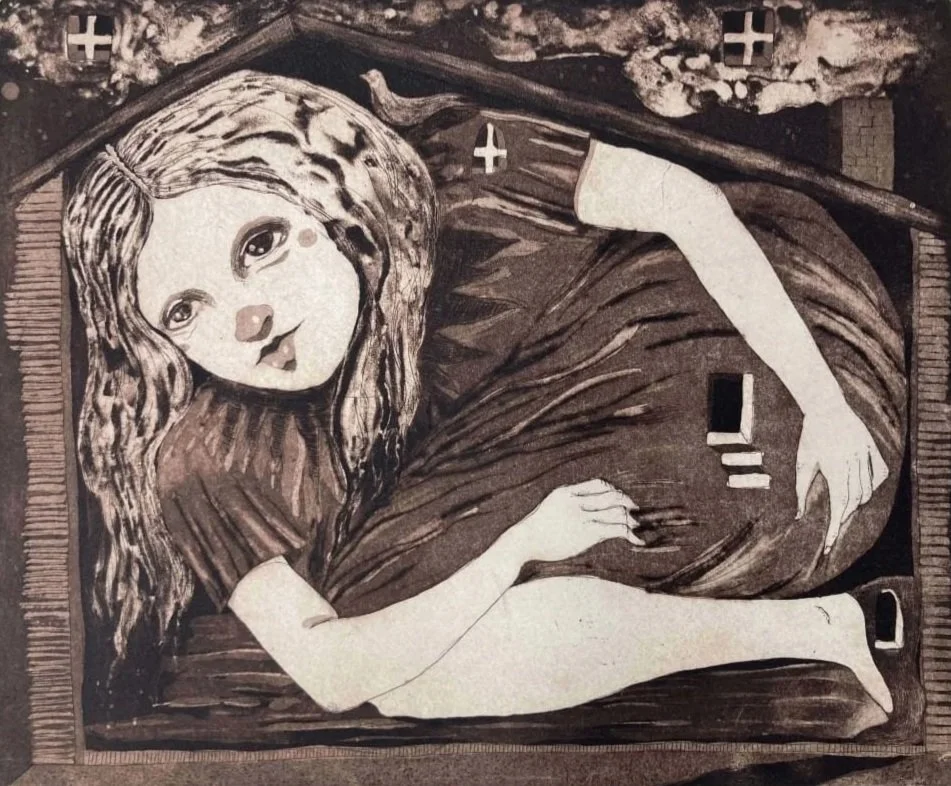
WILHELMINA PEACE | LONGING FOR FIELDS AND FEATHERS, 2025
Wilhelmina Peace creates figurative works that delve into myth, fairy tales, and folklore, employing symbolism and metaphor to dramatize metamorphosis and self-discovery. Dreams serve as a primary source of inspiration, alongside archetypal female figures born from the imagination. Influenced heavily by Surrealism and the unconscious mind’s role in art, the creative process integrates drawing, collage, and printmaking techniques such as etching, lithography, and bookmaking.
Aligned with a belief in the artist’s responsibility to nurture a deeper, more sacred connection to nature and community, the artist embraces eco-feminist principles. Their work aims to raise awareness of the urgent need to reconnect with the environment and our shared humanity, positioning art as a conduit for ecological and social consciousness.
Booth 36
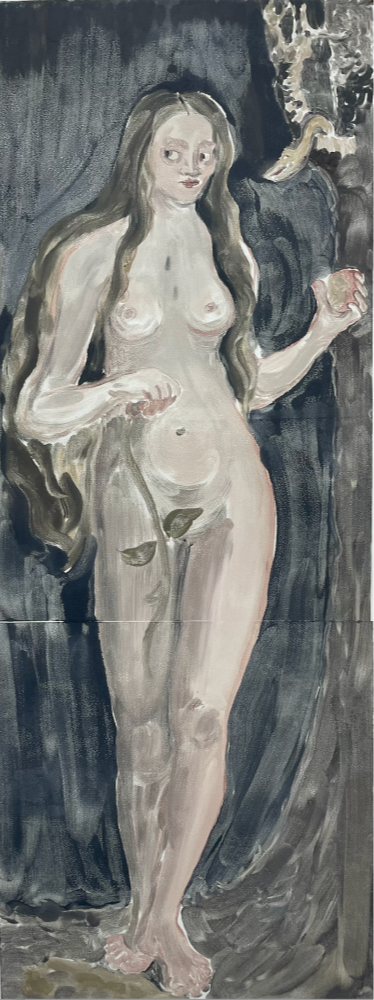
NATASHA MICHAELS | RIPE, 2025
The origins of Natasha Michaels recent monoprints lie in historical paintings from the renaissance to the 19th century. Exploring and reinterpreting traditional conventions and genres, Michaels’ work is an investigation of her own ambivalence towards the originals. This monotype reinterprets Lucas Cranach's Eve . Eve embodied the cautionary tale, punished for her curiosity, she served as proof of woman’s intellectual inferiority and moral frailty. Michaels’s monotype does not correct that image so much as disturb it. Enlarged, distorted, unstable, this new Eve now appears uneasy in this pictorial space, her gaze is exaggerated and uncertain.
The choice of monotype is integral to the reimagining. Monotype resists exact repetition or obedience, each impression is singular, shaped by pressure , accident and the unpredictable migration of ink. The resulting smudges, smears and erasures translate into a visual language of instability. In playing with a revered art historical source, michael's creates what could be called a subtle act of vandalism . Through this reworking, Eve's presence asks how these myths continue to frame women’s bodies, and what happens when the image itself begins to resist its own authority