
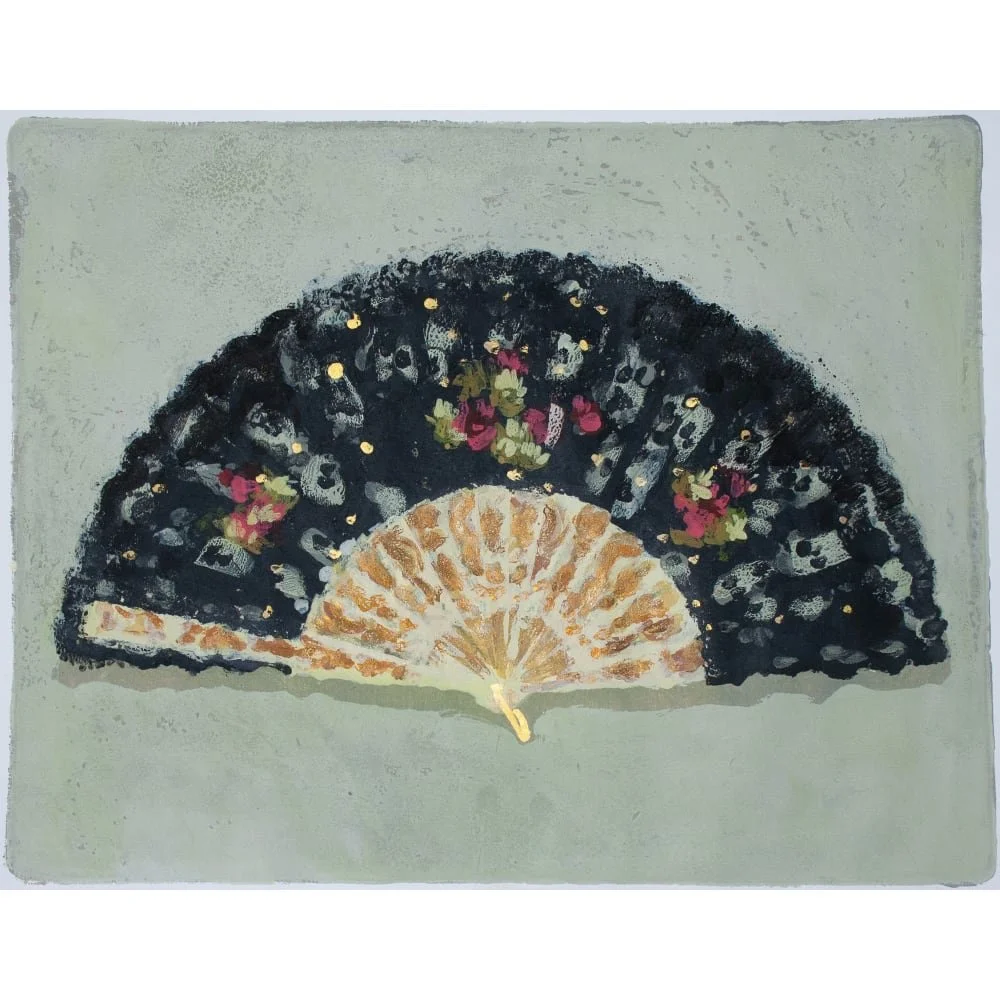
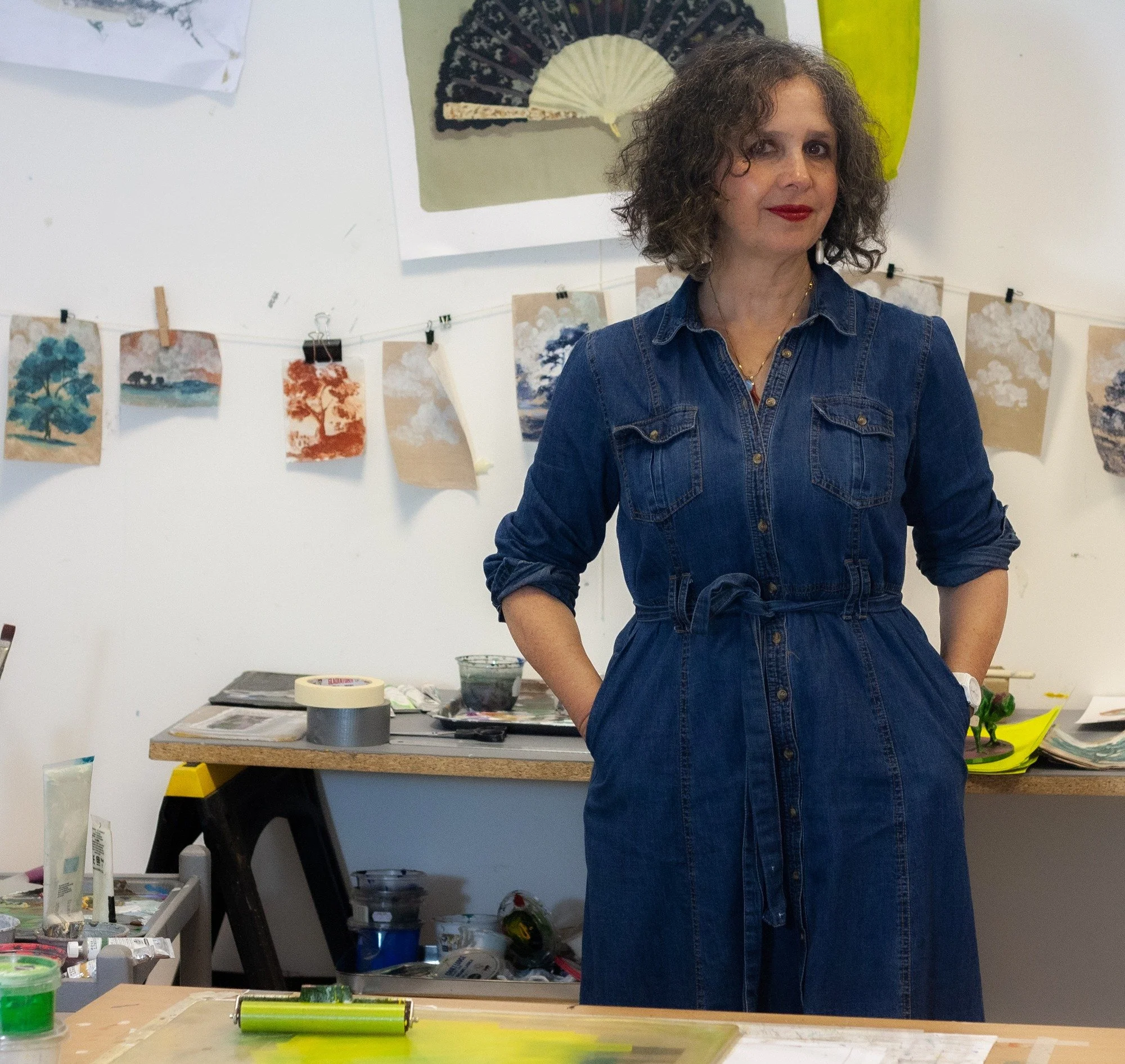
Lucy Newman trained at the RCA and works with printmaking and video. She is exploring her technique of mono printing with gelli plates. As with many printmaking techniques, these plates began with a functional purpose, as cheap, analogue copiers (or hectographs). Lucy’s method involves repeatedly painting on the plate and pressing the paper on the surface, until, as if in a dark room, an image emerges. The prints are then pegged on a string like drying photos. The process is very variable and it dictates the surface like a ceramic glaze in a kiln. Using the moulded gelli plate reminds Lucy of old photography, and its physical magic. She feels like a replicator in the studio, producing multiple representations and pictures as objects. As part of her digital video practice, the prints may be turned into frames in a looping animation, flickering with their differences. Lucy’s imagery is lead by her experiences and interests. Sourced from a large digital photo album, the subjects may be costume, animals, an artefact in a museum, an historical reenactment, a landscape, or a person posed by the sea, or elsewhere. A sense of time or timelessness is a constant theme. The pictures also refer to another fascination, the kind of images you may find in an old coffee table book, called “About the world” or “Knowledge.” She is influenced by historical painting as a way of capturing a shot; she likes paintings of paintings, and the small people in big scenes, made from just a few brush strokes. With the same process, Lucy is also making prints of objects at 100% scale, inspired by pre-photographic Eastern techniques of drawing in 2-d to represent a 3-d object. The works include primary pigments and drop shadows to remind the viewer what the pictures are made of.
Lucy Newman trained at the RCA and works with printmaking and video. She is exploring her technique of mono printing with gelli plates. As with many printmaking techniques, these plates began with a functional purpose, as cheap, analogue copiers (or hectographs). Lucy’s method involves repeatedly painting on the plate and pressing the paper on the surface, until, as if in a dark room, an image emerges. The prints are then pegged on a string like drying photos. The process is very variable and it dictates the surface like a ceramic glaze in a kiln. Using the moulded gelli plate reminds Lucy of old photography, and its physical magic. She feels like a replicator in the studio, producing multiple representations and pictures as objects. As part of her digital video practice, the prints may be turned into frames in a looping animation, flickering with their differences. Lucy’s imagery is lead by her experiences and interests. Sourced from a large digital photo album, the subjects may be costume, animals, an artefact in a museum, an historical reenactment, a landscape, or a person posed by the sea, or elsewhere. A sense of time or timelessness is a constant theme. The pictures also refer to another fascination, the kind of images you may find in an old coffee table book, called “About the world” or “Knowledge.” She is influenced by historical painting as a way of capturing a shot; she likes paintings of paintings, and the small people in big scenes, made from just a few brush strokes. With the same process, Lucy is also making prints of objects at 100% scale, inspired by pre-photographic Eastern techniques of drawing in 2-d to represent a 3-d object. The works include primary pigments and drop shadows to remind the viewer what the pictures are made of.