

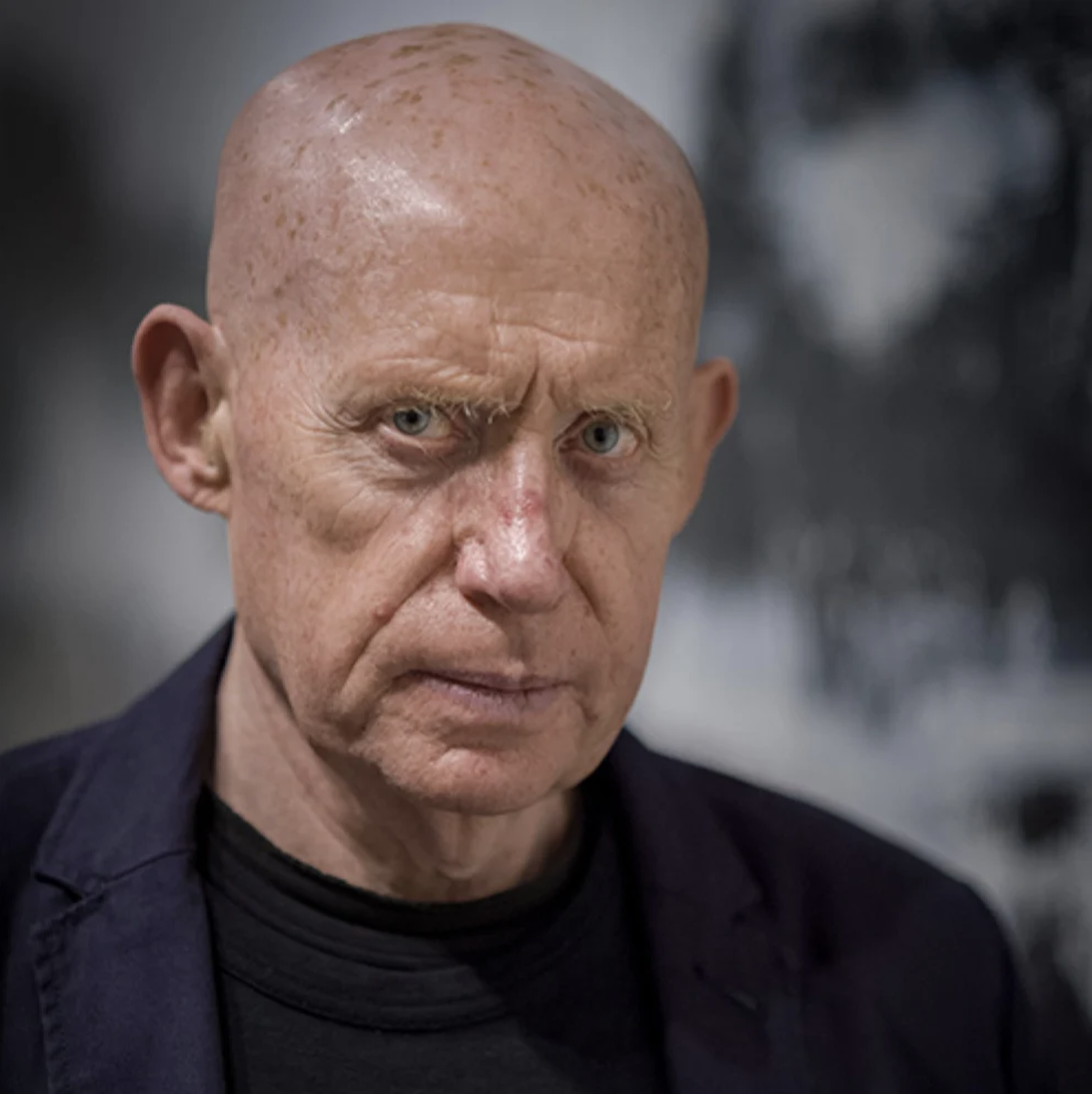
Now in his seventies, John Virtue is considered one of the most distinguished painters working in the United Kingdom today. His work is included in the collections of TATE, London, Walker Art Center, Minneapolis, Yale Center for British Art, New Haven, British Museum, Victoria and Albert Museum, Government Art Collection (UK), Arts Council of England and The Courtauld Institute. He is a painter whose work rides a fine line between figuration and abstraction.
For the last fifty years, Lancashire, the Exe estuary in Devon, London, the Italian landscape and the North Norfolk coast have been the subject of intense ritualistic scrutiny, always rendered in black and white.
In 2003, he became the sixth associate artist at The National Gallery, London, a scheme that allowed an invited contemporary artist to connect with the collection to produce work inspired by the Old Master tradition. Culminating in 2005, a group of monumental London skyline paintings were exhibited at this flagship public institution.
In 2009, John moved from Italy to North Norfolk, where he wrestled with the enormity of the sea, sky, and weather around Cley-next-the-Sea and Blakeney Point. Since 2020, he has worked from a studio in Hertfordshire.
His work has been deeply influenced by giants of the past, such as John Constable, Samuel Palmer, and J M W Turner, as well as twentieth-century greats Franz Kline, Robert Ryman and Jackson Pollock. Japanese calligraphy has also left a profound mark on his painting, a testament to his admiration of Ike no Taiga (Edo period) and Sengai Gibon (Rinzai School).
In 2019, a monograph covering over forty years of John's work was published by ALBION Ridinghouse. This two-hundred-and-eighty-five-page illustrated book provides a substantial overview of the development of Virtue's art. It traces his close relationship with locations in Devon, Exeter, London, Italy and Norfolk. The critical text is provided by Paul Moorhouse, Ex TATE and previously, Senior Curator, 20th Century Collections, National Portrait Gallery.
Now in his seventies, John Virtue is considered one of the most distinguished painters working in the United Kingdom today. His work is included in the collections of TATE, London, Walker Art Center, Minneapolis, Yale Center for British Art, New Haven, British Museum, Victoria and Albert Museum, Government Art Collection (UK), Arts Council of England and The Courtauld Institute. He is a painter whose work rides a fine line between figuration and abstraction.
For the last fifty years, Lancashire, the Exe estuary in Devon, London, the Italian landscape and the North Norfolk coast have been the subject of intense ritualistic scrutiny, always rendered in black and white.
In 2003, he became the sixth associate artist at The National Gallery, London, a scheme that allowed an invited contemporary artist to connect with the collection to produce work inspired by the Old Master tradition. Culminating in 2005, a group of monumental London skyline paintings were exhibited at this flagship public institution.
In 2009, John moved from Italy to North Norfolk, where he wrestled with the enormity of the sea, sky, and weather around Cley-next-the-Sea and Blakeney Point. Since 2020, he has worked from a studio in Hertfordshire.
His work has been deeply influenced by giants of the past, such as John Constable, Samuel Palmer, and J M W Turner, as well as twentieth-century greats Franz Kline, Robert Ryman and Jackson Pollock. Japanese calligraphy has also left a profound mark on his painting, a testament to his admiration of Ike no Taiga (Edo period) and Sengai Gibon (Rinzai School).
In 2019, a monograph covering over forty years of John's work was published by ALBION Ridinghouse. This two-hundred-and-eighty-five-page illustrated book provides a substantial overview of the development of Virtue's art. It traces his close relationship with locations in Devon, Exeter, London, Italy and Norfolk. The critical text is provided by Paul Moorhouse, Ex TATE and previously, Senior Curator, 20th Century Collections, National Portrait Gallery.