
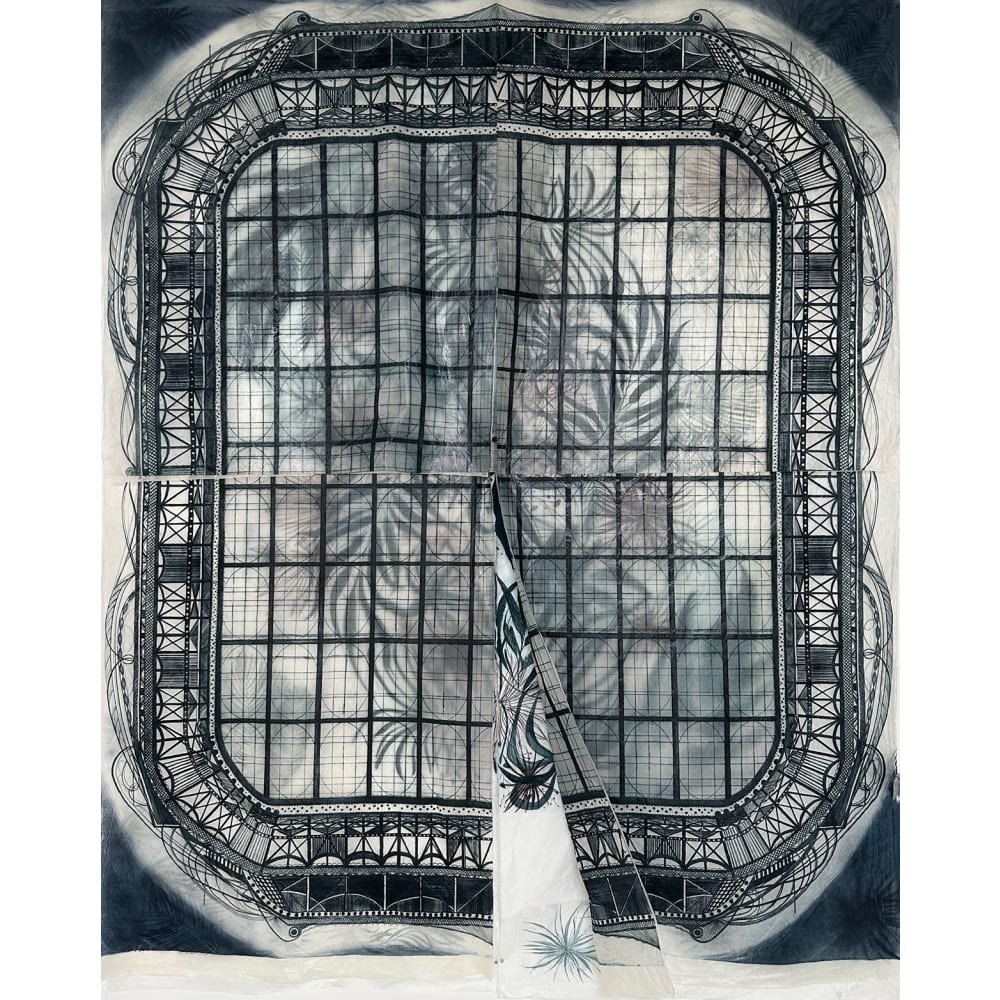

Interested in the peculiar transience of the urban built environment, the impermanence of what is ostensibly permanent, Robinson’s practice emerges from the observation and study of a variety of structures and architectures that frame contemporary urban experience, from scaffolding to bridges, billboards, demolitions and new constructions. She begins most of her printmaking projects with observational drawings and photographs, which she then redraws until the forms take on a life of their own, and point us towards a world that we recognize, but that isn’t quite real, a dream architecture built from the tessellations of memory and materials. Robinson prefers to work in small editions, where each print is different. While the first print she pulls typically emerges from her observational sketches, each subsequent print is determined by work on the plate, or by the use of alternate colours. She allows the printing process to guide her, asking what happens here if I change the palette, fold or tear the print. Scale and choice of paper, are vital elements to the meaning of the work. Large sheets of strong but nearly transparent Japanese papers, which look fragile, but are actually very strong, create a counterbalance between the subject and the materials.
Interested in the peculiar transience of the urban built environment, the impermanence of what is ostensibly permanent, Robinson’s practice emerges from the observation and study of a variety of structures and architectures that frame contemporary urban experience, from scaffolding to bridges, billboards, demolitions and new constructions. She begins most of her printmaking projects with observational drawings and photographs, which she then redraws until the forms take on a life of their own, and point us towards a world that we recognize, but that isn’t quite real, a dream architecture built from the tessellations of memory and materials. Robinson prefers to work in small editions, where each print is different. While the first print she pulls typically emerges from her observational sketches, each subsequent print is determined by work on the plate, or by the use of alternate colours. She allows the printing process to guide her, asking what happens here if I change the palette, fold or tear the print. Scale and choice of paper, are vital elements to the meaning of the work. Large sheets of strong but nearly transparent Japanese papers, which look fragile, but are actually very strong, create a counterbalance between the subject and the materials.