
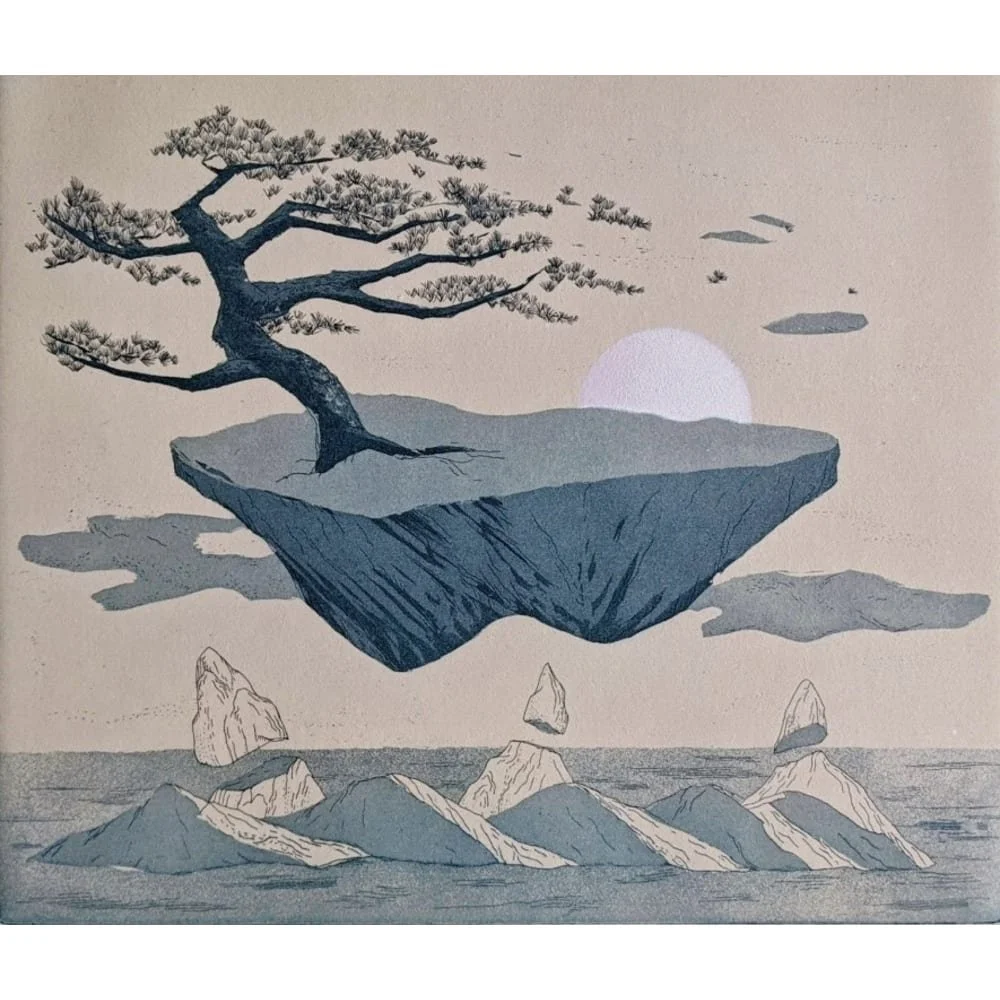
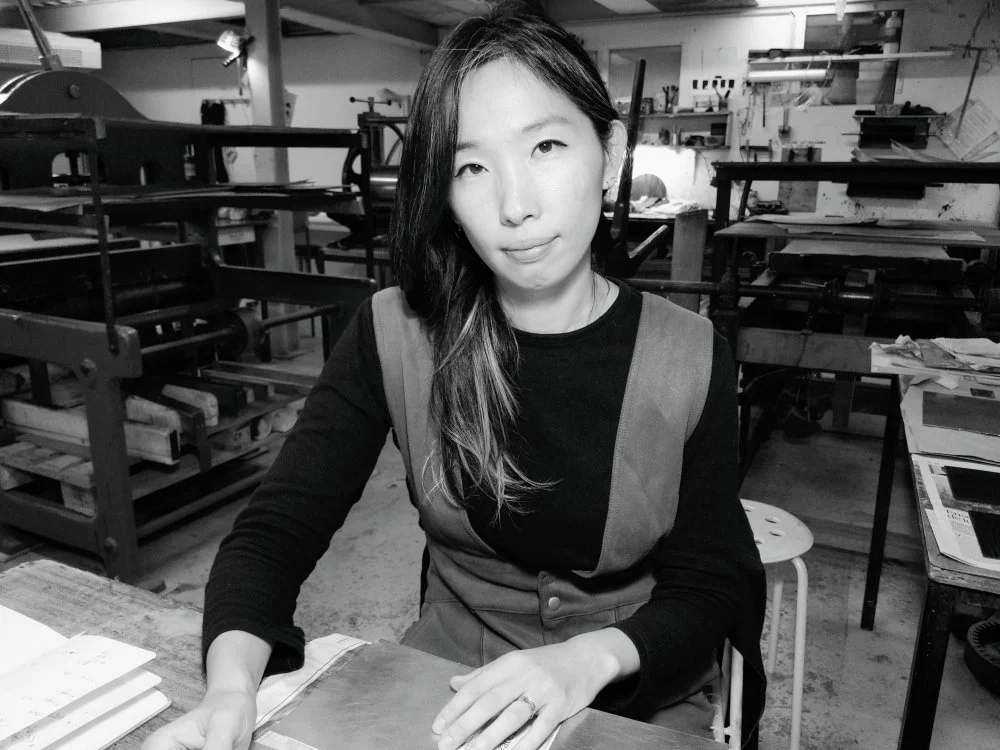
Ema Kawanago’s work explores the poetic tension between gravity and memol9ry through the medium of printmaking. Her ongoing series Levitation, begun in 2018, liberates geological forms from their earthly constraints. Stones and minerals hover in serene defiance of gravity, inviting reflection on presence, ancestry, and invisible forces. Her prints evoke a “floating world” where weight is suspended and meaning becomes fluid. Strongly influenced by the visual language of Japanese Ukiyo-e, her prints carry subtle references to memory, daily life, and spiritual transience. Drawing on her background in ecosystem science and her lifelong connection to Japan’s mountainous and coastal landscapes, she investigates how natural materials—stones, minerals, sediments—can embody time, resilience, and transformation. Her work employs a variety of traditional intaglio techniques—etching, aquatint, soft and hard ground, drypoint—as well as lithography and linocut to create layered and atmospheric compositions. She studied Biological Sciences in Japan and France, earning a Master’s degree from the University of Bordeaux in 2008 before fully transitioning into visual arts. In 2015, she received a grant from the Japan Foundation in New Delhi, and her works are now part of their collection. She was awarded the Grand Prize at the Young Artists Competition in Nagoya in 2020, and received the Taylor Foundation Prize at the Salon d’Art et Matière in 2024.
Ema Kawanago’s work explores the poetic tension between gravity and memol9ry through the medium of printmaking. Her ongoing series Levitation, begun in 2018, liberates geological forms from their earthly constraints. Stones and minerals hover in serene defiance of gravity, inviting reflection on presence, ancestry, and invisible forces. Her prints evoke a “floating world” where weight is suspended and meaning becomes fluid. Strongly influenced by the visual language of Japanese Ukiyo-e, her prints carry subtle references to memory, daily life, and spiritual transience. Drawing on her background in ecosystem science and her lifelong connection to Japan’s mountainous and coastal landscapes, she investigates how natural materials—stones, minerals, sediments—can embody time, resilience, and transformation. Her work employs a variety of traditional intaglio techniques—etching, aquatint, soft and hard ground, drypoint—as well as lithography and linocut to create layered and atmospheric compositions. She studied Biological Sciences in Japan and France, earning a Master’s degree from the University of Bordeaux in 2008 before fully transitioning into visual arts. In 2015, she received a grant from the Japan Foundation in New Delhi, and her works are now part of their collection. She was awarded the Grand Prize at the Young Artists Competition in Nagoya in 2020, and received the Taylor Foundation Prize at the Salon d’Art et Matière in 2024.