
Bingqing Liu
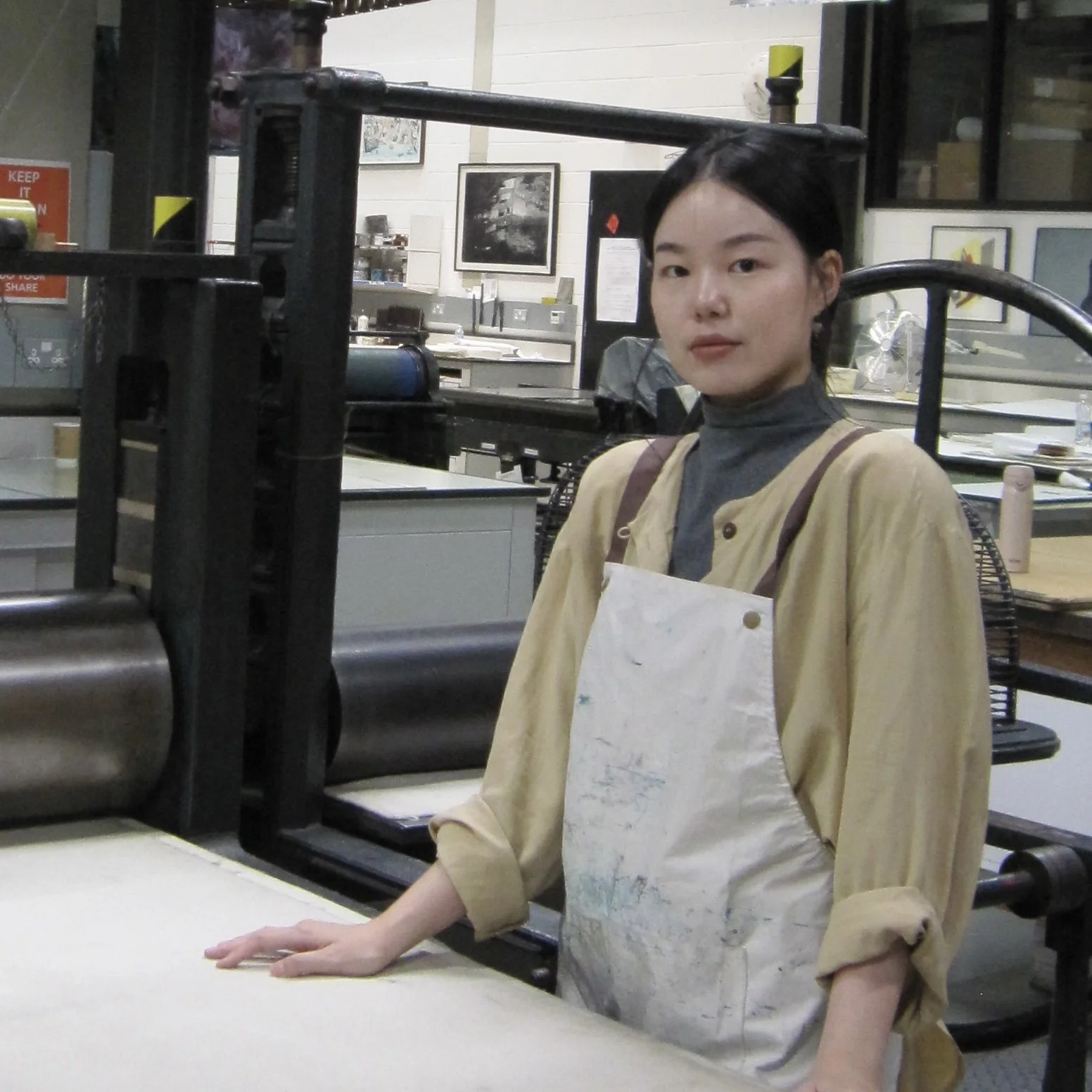
Bingqing Liu, born in 2000 in China, is an artist whose practice is rooted in printmaking and extends into traditional crafts such as embroidery. She holds a BA in Printmaking from Xi’an Academy of Fine Arts in China and an MA in Print from the Royal College of Art in the UK. Her work focuses on the transformative possibilities of material language within contemporary art, exploring the relationship between personal experience, cultural memory, and visual expression.
Bingqing’s artistic process is deeply influenced by natural sounds, minimalist music structures, and rhythmic repetition. Through traditional printmaking techniques such as drypoint and etching, she repeatedly carves lines onto metal plates, employing temporality and repetition as key creative strategies. These lines serve both as physical traces and emotional records, reflecting her ongoing interest in visualizing time and the perception of rhythm.
In recent years, Bingqing has integrated Suzhou embroidery (Su Xiu) into her printmaking practice, further enriching the cultural and expressive dimensions of her work through cross-media fusion. As an intangible cultural heritage, Su embroidery embodies her regional identity and childhood memories, providing a point of entry for exploring contemporary interpretations of traditional craftsmanship. She perceives the highly focused bodily labor and delicate, repetitive movements of embroidery as resonant with the carving logic of printmaking, deepening her engagement with Eastern aesthetics and meditative states.
Her work also adopts a feminist perspective, contributing to contemporary discussions around traditional female labor. By highlighting the "invisible labor" and embodied sensory experiences inherent in practices like embroidery and weaving, Bingqing challenges the sensory alienation brought about by mechanization and digitalization in modern society. She reasserts
the emotional warmth and bodily memory embedded in handcrafted work, focusing not only on the formal translation of craft but also on its spiritual and cultural transmission.
Starting from the language of materials, Bingqing aims to create a dialogue between traditional craft and contemporary visual art. Centering on the cultural significance and spiritual qualities of Su embroidery and other intangible heritage techniques, she approaches her work through the lens of Eastern philosophy and aesthetics, probing pathways for contemporary expression.
Her practice investigates the intersections of personal identity, female experience, and collective culture, striving to convey a gentle yet resilient emotional tension and to invite the viewer to reawaken their sensitivity to nature, the body, and time.
Bingqing Liu, born in 2000 in China, is an artist whose practice is rooted in printmaking and extends into traditional crafts such as embroidery. She holds a BA in Printmaking from Xi’an Academy of Fine Arts in China and an MA in Print from the Royal College of Art in the UK. Her work focuses on the transformative possibilities of material language within contemporary art, exploring the relationship between personal experience, cultural memory, and visual expression.
Bingqing’s artistic process is deeply influenced by natural sounds, minimalist music structures, and rhythmic repetition. Through traditional printmaking techniques such as drypoint and etching, she repeatedly carves lines onto metal plates, employing temporality and repetition as key creative strategies. These lines serve both as physical traces and emotional records, reflecting her ongoing interest in visualizing time and the perception of rhythm.
In recent years, Bingqing has integrated Suzhou embroidery (Su Xiu) into her printmaking practice, further enriching the cultural and expressive dimensions of her work through cross-media fusion. As an intangible cultural heritage, Su embroidery embodies her regional identity and childhood memories, providing a point of entry for exploring contemporary interpretations of traditional craftsmanship. She perceives the highly focused bodily labor and delicate, repetitive movements of embroidery as resonant with the carving logic of printmaking, deepening her engagement with Eastern aesthetics and meditative states.
Her work also adopts a feminist perspective, contributing to contemporary discussions around traditional female labor. By highlighting the "invisible labor" and embodied sensory experiences inherent in practices like embroidery and weaving, Bingqing challenges the sensory alienation brought about by mechanization and digitalization in modern society. She reasserts
the emotional warmth and bodily memory embedded in handcrafted work, focusing not only on the formal translation of craft but also on its spiritual and cultural transmission.
Starting from the language of materials, Bingqing aims to create a dialogue between traditional craft and contemporary visual art. Centering on the cultural significance and spiritual qualities of Su embroidery and other intangible heritage techniques, she approaches her work through the lens of Eastern philosophy and aesthetics, probing pathways for contemporary expression.
Her practice investigates the intersections of personal identity, female experience, and collective culture, striving to convey a gentle yet resilient emotional tension and to invite the viewer to reawaken their sensitivity to nature, the body, and time.